TL;DR
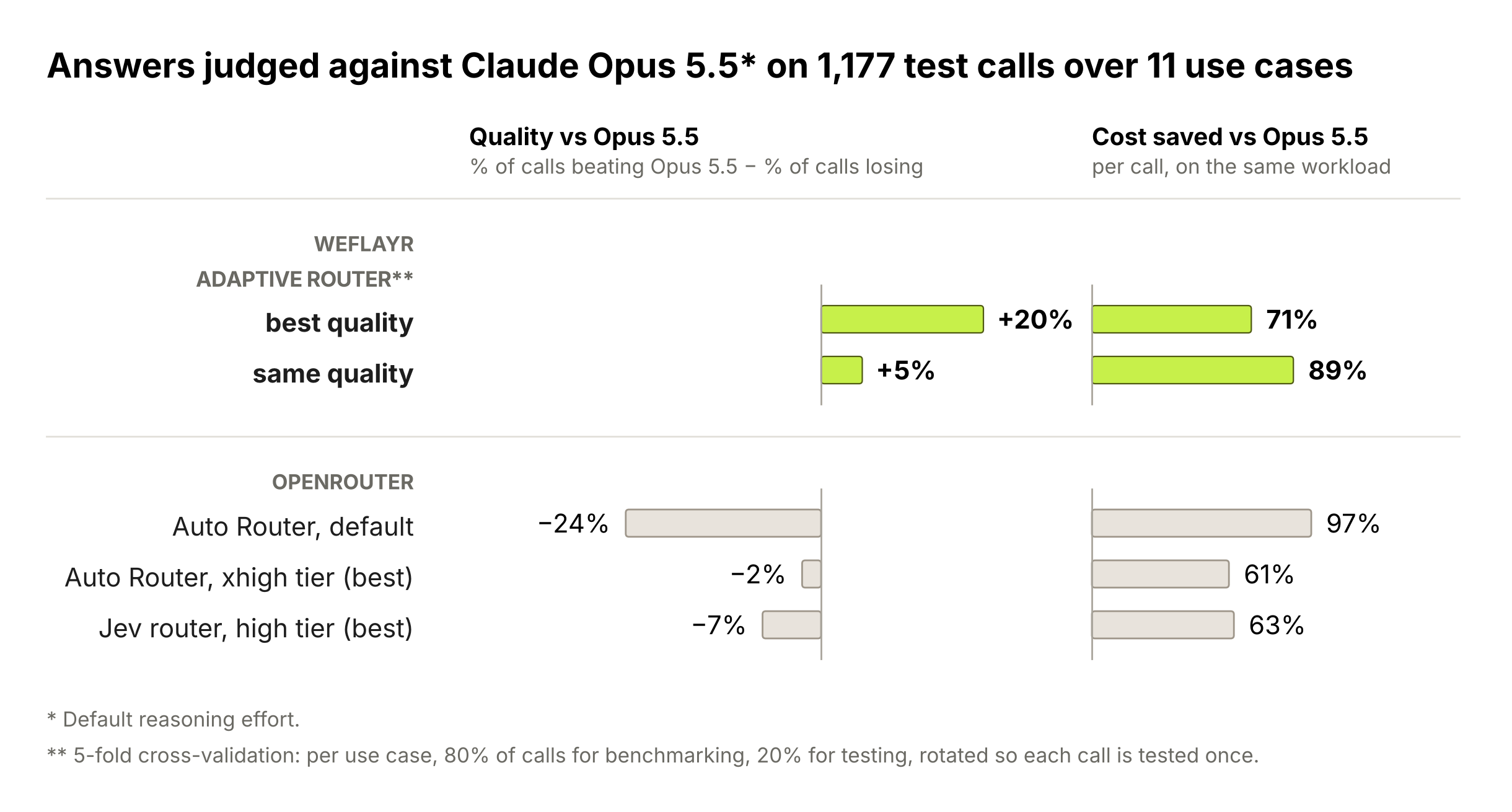
You shouldn't have to trade quality for cost for your LLM calls. Weflayr's Adaptive Router gives you both, with two optimisation modes: Best Quality scores +20 quality points at 71% lower cost than Opus 5.5, and Same Quality +5 points at 89% lower cost.
Against OpenRouter's best router (Auto Router, xhigh), they score +22 and +7 points respectively, at 25% and 72% lower cost.
In the above results, quality is measured by comparing each routed model's answers with those of Opus 5.5.
Most LLM routers rely on classifiers trained on generic data, which poorly predict how models perform on a specific use case. On top of that, switching models is risky: a model that scores higher on public benchmarks can still degrade an agent's behavior.
We address both problems with an approach we call Adaptive Routing. It benchmarks candidate models on a use case's past requests, then routes each new request based on how each model performed on similar requests. Teams can review each model's results on their own workloads before switching any production traffic.
The dataset and results are available on Hugging Face.
1. One model for every request is expensive
Hundreds of AI models are available, each with different strengths. Yet most AI products still send every request to one model, because choosing a model per request without sacrificing quality is hard.
The most cost-effective model varies from request to request, and only a product's own requests can show which model performs best for each one.
Most off-the-shelf routers rely on classifiers trained on generic data to predict which model to send requests to. At the same time, teams often rely on public benchmarks to compare and select models, even though these measure performance on someone else's tasks. Neither tells teams how the models will actually perform on their own requests. As a result, switching to a model that looks better on paper can still degrade an agent's behavior.
We built Weflayr's router around that missing signal. It first benchmarks candidate models on a use case's own requests, against the model(s) it uses today. It then routes each new call based on how each candidate performed on similar calls, according to the team's predefined cost and quality objectives.
Unlike generic classifiers, the router learns each use case's specific instructions, tools and recurring patterns, allowing it to focus on the request-specific signals that matter most for model selection. We call that Adaptive Routing.
2. Adaptive Routing in more detail
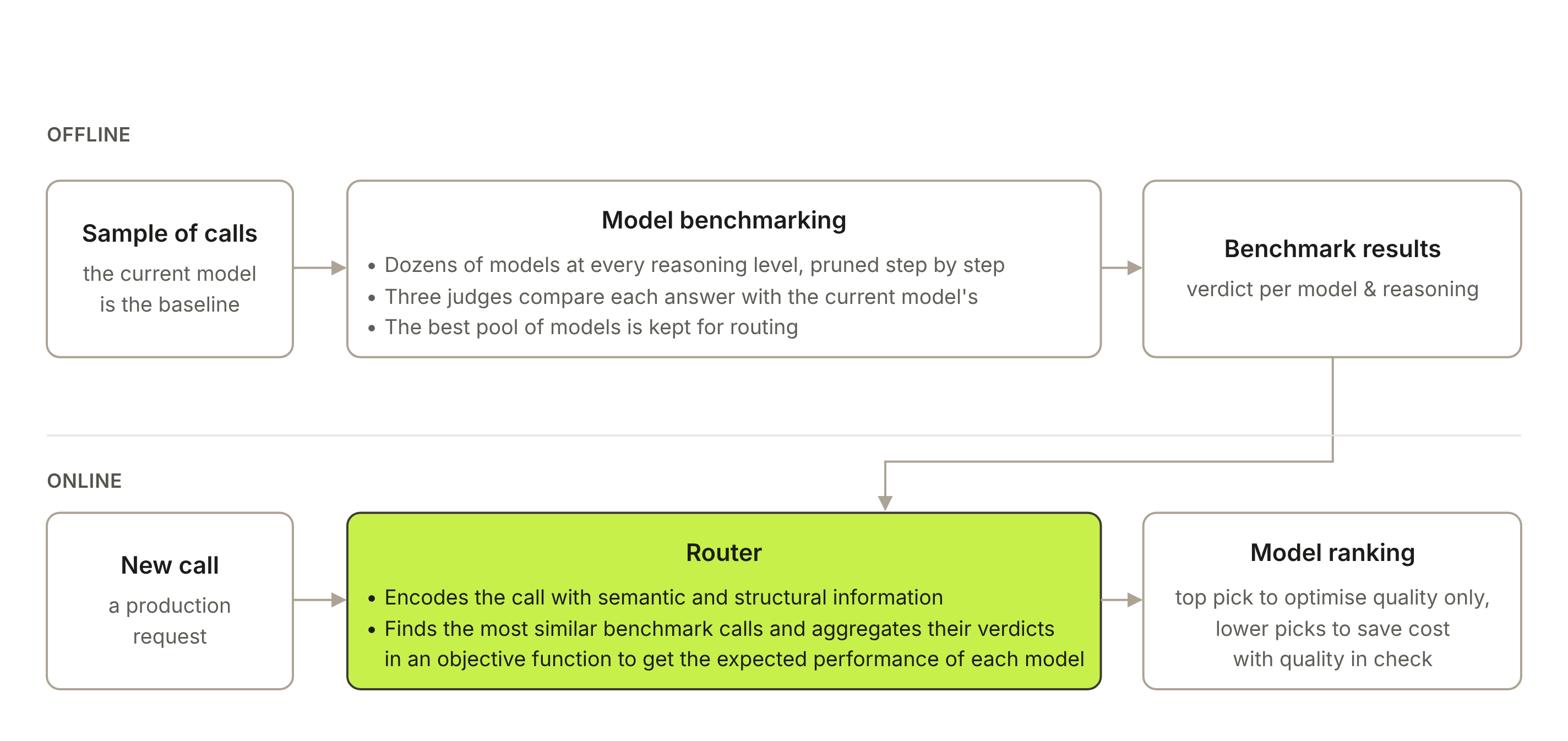
First, we benchmark models using a sample of a use case's calls. Then, the router applies what it learned to route every new call.
Model benchmarking
The benchmarking phase evaluates candidate models across all reasoning levels. The candidate models are chosen based on their prices, to meet pre-defined cost objectives. Based on these results, it iteratively explores different model combinations using the router (described below) to identify the mix that maximizes quality.
Judging the quality of an answer
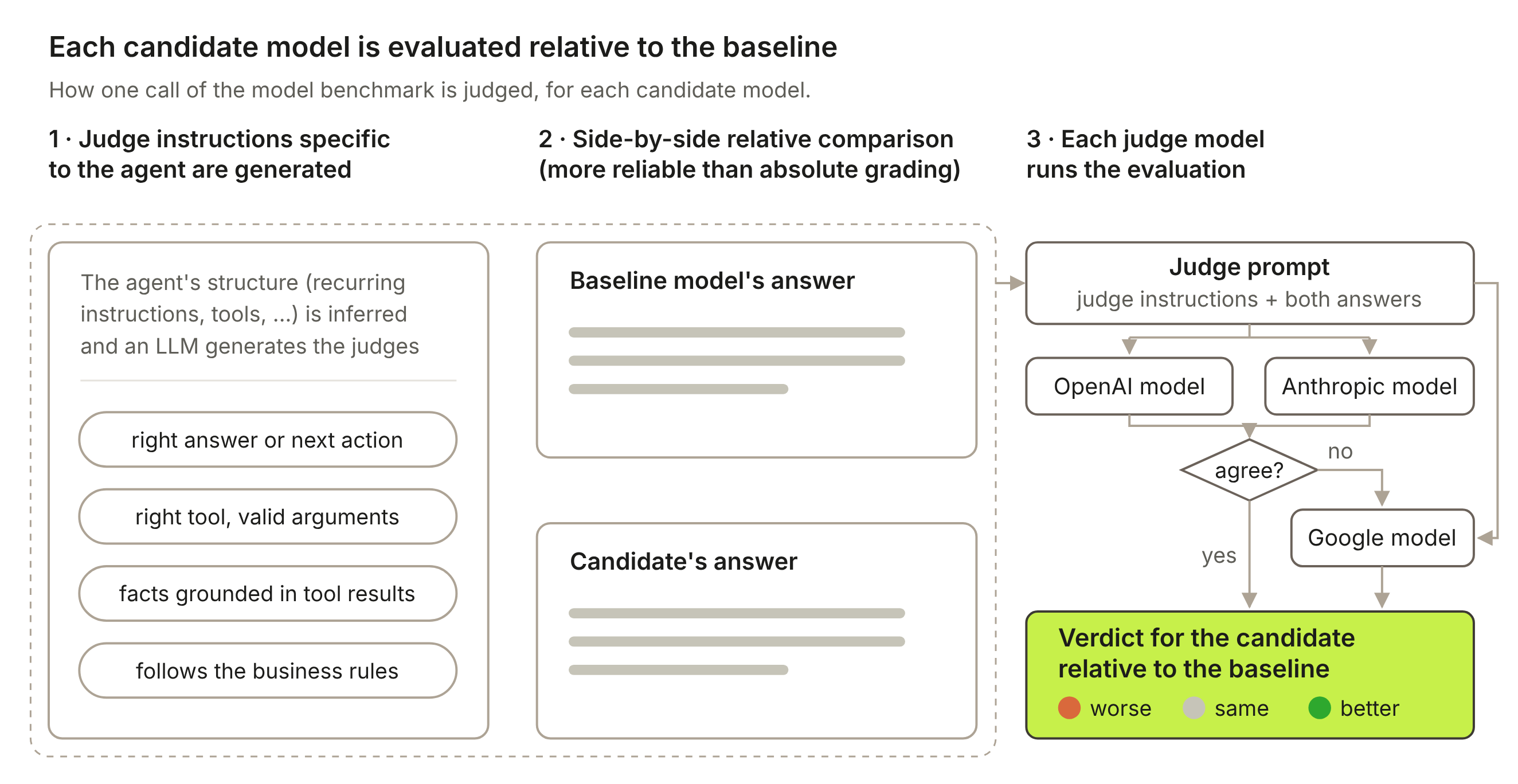
1. We generate specialized evaluation criteria by parsing the agent's requests to identify its instructions, tools, response formats and recurring patterns, focusing on the business context. PS: In the product, users can review these criteria and add their own.
2. We compare candidate model answers side by side with the baseline's answer, so every result is relative. For each benchmark call, the judge sees the request, the baseline model's answer and the candidate model's answer, then decides whether the candidate is better, equivalent or worse than the baseline.
This is a deliberate choice. Absolute grading (“is this answer correct?”) is often unreliable in real-world applications, even when compared against a ground truth. Answers can be partially correct, omit information or include unnecessary details, making even human experts disagree on how to grade them. Side-by-side comparison makes evaluation more reliable for LLMs and more relevant to routing: it tells us whether switching models improves or degrades the result, regardless of whether the baseline answer itself is good or bad.
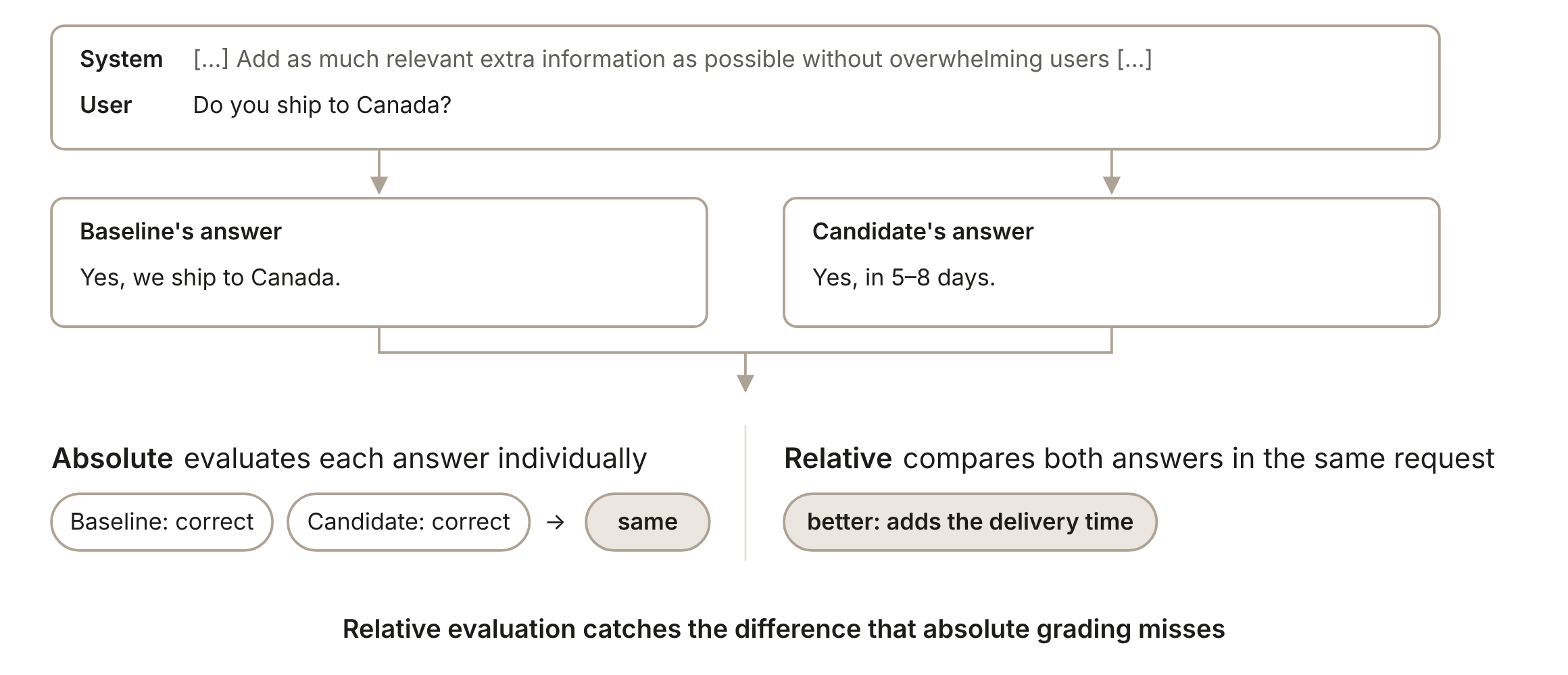
Side-by-side relative grading also shows better where a candidate improves or degrades production behaviour, helping teams decide whether switching is worthwhile.
3. A single judge can introduce provider-specific bias, favoring answers generated by models from its own provider. To mitigate this, we use a panel of judges from three different providers.
Router
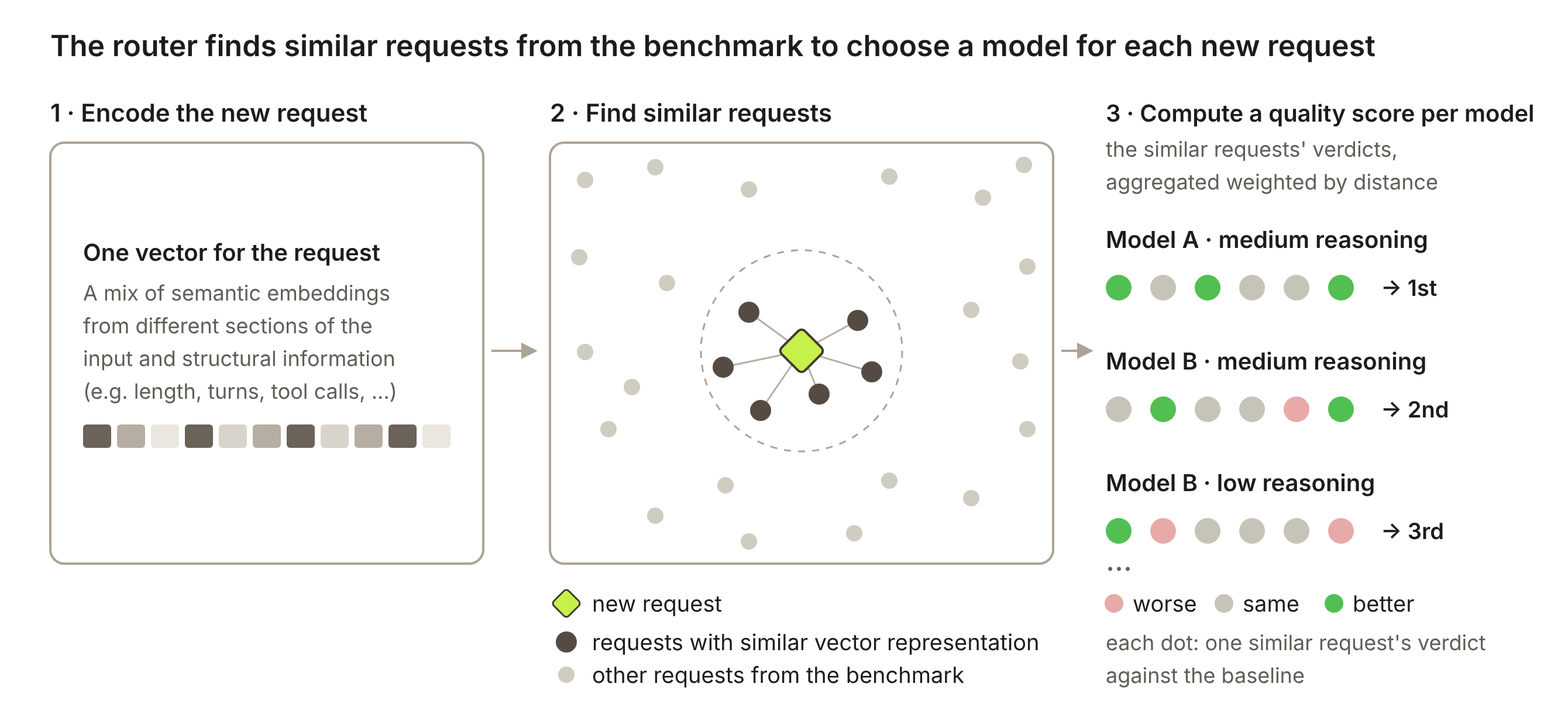
For every incoming call, the router finds the benchmark calls most similar to it and looks at how each candidate model performed on those calls. By aggregating their verdicts, weighted by similarity, it estimates which models are most likely to match or beat the baseline model's quality for that specific request.
Finding similar calls
To identify similar calls, the router combines two signals:
- Semantic: embeddings capturing what the request is about, such as the latest message or tool definitions.
- Structural: features such as request length, number of turns and tool calls, capturing the shape of the call.
Predicting each model's quality relative to the baseline
For each candidate model, the router looks at how it performed on the most similar benchmark calls, giving more weight to calls that are closer to the incoming request.
This produces a quality score per model: an estimate of the likelihood that its answer will be as good as or better than the current model's.
Choosing which model to call
The router selects a model according to the chosen quality-cost objective:
- Best quality: selects the model with the highest predicted quality score, using the cheapest model to break ties.
- Same quality: selects the cheapest model whose predicted quality meets or exceeds the baseline's.
3. Experiment & results
Experimental setup
We evaluated our Adaptive Router on 1,177 test calls across 11 use cases: 10 from the public SOPBench and τ²-bench benchmarks, and one from anonymised production traffic. Each use case shares the same system prompt across its requests. We used 5-fold cross-validation: for each use case, the router was benchmarked on 80% of the calls and tested on the remaining 20%, rotating the split so that every call was tested exactly once and never seen during benchmarking. The dataset and results are available on Hugging Face.
We compared our method against two alternatives:
- Claude Opus 5.5 alone (default reasoning): the quality baseline.
- OpenRouter's routing solutions: Auto Router and Jev Router, both included as relevant market references. Jev-based routing has attracted significant attention, making it particularly interesting to evaluate its actual performance.
The candidate model pool considered by the routers comprised 18 models across 9 providers:
- OpenAI: GPT-6 Luna, GPT-6 Sol, GPT-6.1 Sol
- Anthropic: Claude Opus 5.5, Claude Sonnet 5.5
- Google: Gemini 3.8 Flash, Gemini 3.5 Flash-Lite, Gemini 3.1 Pro Preview
- xAI: Grok 4.7
- Moonshot: Kimi K3
- Alibaba: Qwen 3.8 Max, Qwen 3.8 27B, Qwen 3.8 Flash
- Z.ai: GLM 5.3
- DeepSeek: DeepSeek V4 Pro, DeepSeek V4.1 Flash
- Mistral: Mistral Medium 3.5, Mistral Small 2603
Methodology
We measured quality as the percentage of calls where a strategy's answer is judged better than Opus 5.5 minus the percentage where it is judged worse. Ties count as neither. A positive score therefore indicates a net quality improvement over Opus.
Answers were evaluated by GPT-6 Luna and Claude Haiku 5.5, with Gemini 3.8 Flash resolving disagreements.
For all costs, we assumed zero cached tokens to avoid bias.
Results
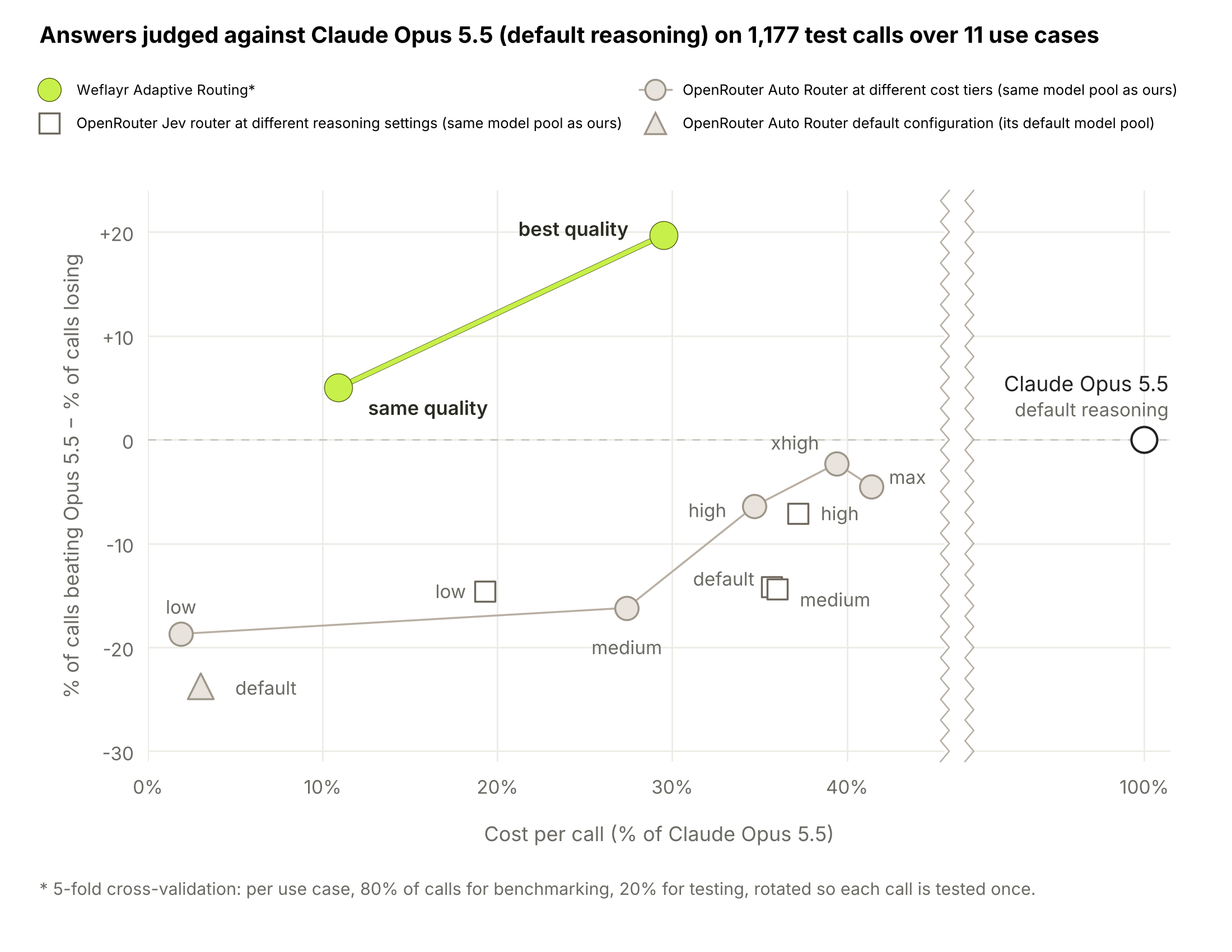
Weflayr achieves a stronger quality-cost trade-off across both routing modes:
- Our best quality mode outperforms both Opus 5.5 (+20 points, 71% lower cost) and OpenRouter's best-performing Auto Router configuration, xhigh (+22 points, 25% lower cost), on quality and cost.
- Our same quality mode slightly exceeds Opus 5.5's quality (+5 points) at 89% lower cost, making it by far the cheapest option that preserves baseline quality.
Comparison with LLMRouterBench, an official benchmark
We evaluated Weflayr on LLMRouterBench (Li et al., 2026), a public benchmark providing model outputs, accuracy scores and costs across 10 tasks. Its released results cover 13 models and six published routing methods across different configurations, including OpenRouter's Auto Router.
We followed the benchmark's evaluation protocol: for each task, we used 70% of the prompts to benchmark and calibrate our router, then evaluated it on the remaining 30% using pre-annotated model results to determine whether each selected model gives a correct answer, repeating the process across five different splits and using GPT-5 as the strongest single-model baseline.
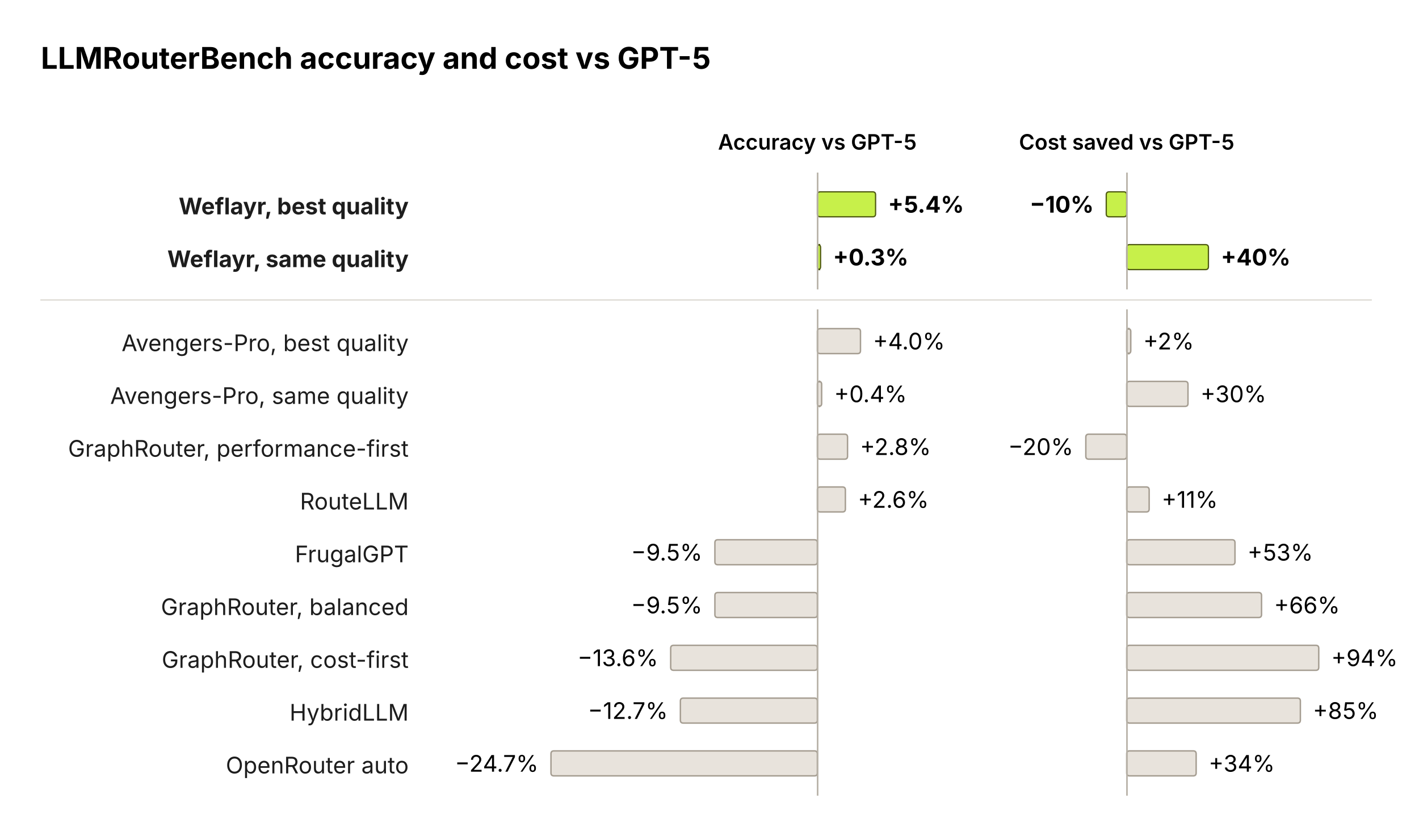
- Best quality: Weflayr achieves 5.4% higher accuracy than GPT-5 at 10% higher cost, outperforming the best published router, Avengers-Pro (+4.0%), but at a 12.2% higher cost.
- Same quality: Weflayr matches GPT-5's accuracy (+0.3%) while reducing cost by 40%, compared with 30% for Avengers-Pro.
Across both quality modes, Adaptive Routing consistently delivers a better quality-cost trade-off than the routing alternatives tested. The gains are larger on our main benchmark, where the router is calibrated on a single use case. That's because Weflayr isn't built to find the best model in general, but the best model for your application, by learning its specific request patterns and quality requirements.
Beyond model selection, Weflayr is purpose-built for production AI
Adaptive Routing is only part of what it takes to run AI models reliably in production. Weflayr also gives teams fine-grained control over how their models are used.
Caching-aware optimisation & routing
During benchmarking, Weflayr analyses historical calls to identify each model's optimal caching configuration and breakpoints, which can then be enforced in production.
At runtime, Weflayr reuses the same model across requests sharing the same cache, maximizing prompt-cache hits to reduce latency and cost. Teams can configure when Weflayr is allowed to break the cache when the current model is unlikely to meet the required quality. This avoids a common limitation of other routers: locking an agent into a cheaper model after an easy request, even when a subsequent, more demanding request needs a stronger one.
Control and reliability
Teams can define granular routing rules based on quality, cost and business-specific requirements, including customer-level context and economics.
Weflayr also automatically adapts requests to each model to preserve consistent behaviour across providers, and “self-heals” to avoid 400 errors (e.g. when passing temperature to a model that doesn't support it). If a model is unavailable or unhealthy, requests are automatically routed to a fallback.
Developer-friendly workflows
Weflayr can be configured either through the UI or directly through coding-agent skills. Whether connecting your application, benchmarking calls, inspecting results or defining routing strategies, everything is designed to be straightforward and accessible.